Why Families and Scientists Need Each Other In Neuroblastoma Research

Every discovery in childhood cancer begins with a question — often one asked first by a parent.


In our July webinar, Dr. Giselle Sholler, Chair of the Beat Childhood Cancer Research Consortium, shared an insider’s view of what true collaboration between families and scientists looks like — and why it’s the driving force behind every breakthrough in neuroblastoma research.

The Power of Partnership

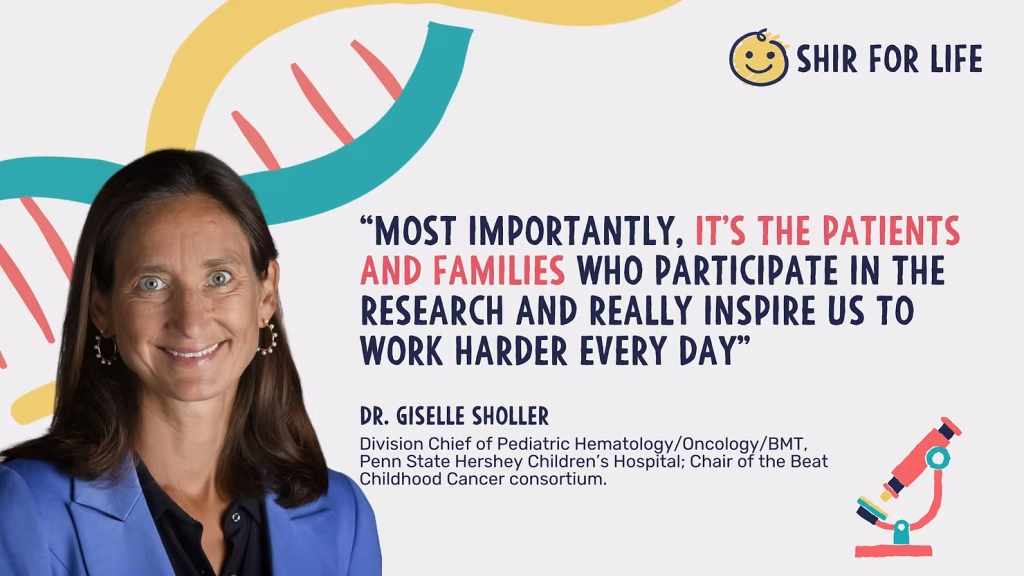
“Most importantly, it’s the patients and families who participate in the research and really inspire us to work harder every day,” Dr. Sholler said.

Behind every clinical advance are families who make it possible — enrolling in trials, asking questions no one else is asking, and insisting that progress move faster.

When families and scientists share one goal, the results are remarkable. Over 55 hospitals across the U.S. and Canada — with plans to expand to Spain, Brazil, and Israel  — collaborate through the Beat Childhood Cancer Research Consortium, where family advocacy directly fuels new trials and precision medicine projects.

From Possibility to Proof: The Story of DFMO


The FDA approval of DFMO (Iwilfin™) in 2023 marked a turning point in neuroblastoma care — not only because it helps prevent relapse, but because it was built on a model of family-driven research.

“Three children, who were told that they were incurable… have now been 10 years since completing the study and remain in remission.” — Dr. Giselle Sholler

Families were the first to believe that relapse prevention was possible, and their participation made the data real. The name itself, Iwilfin™, honors two children — Will and Finn — whose stories are woven into the drug’s journey from lab bench to FDA approval.

DFMO is more than a medication. It’s proof that when families and scientists work in unison, hope can fuel action.

A New Era of Research

Today, Dr. Sholler’s team continues to expand that model.

 
  1. Precision Medicine: Whole-exome and transcriptome sequencing help tailor treatment to each child’s biology.

  2. Combination Trials: New studies are testing DFMO with other agents to improve survival for children who relapse.

  3. Global Access: The consortium’s reach is widening so that breakthroughs are not limited by geography.


This is what collaborative science looks like — rigorous, data-driven, and powered by families’ determination.

Lighting the Future Together

“Your success is our success,” said Dr. Sholler, echoing the shared spirit that defines this work.

For every family, progress depends on connection: between parents and doctors, between labs and homes, between courage and discovery.

This November, the Shir for Life Gala: Light the Future will celebrate that connection — honoring families, scientists, and partners shaping a better tomorrow for children with neuroblastoma.

👉 Reserve your seat at the Shir for Life Gala – Light the Future

Recent posts

Webinar Series

Webinar Series

Neuroblastoma Webinar Series — Watch On Demand Every month, Shir for Life brings together families, clinicians and advocates from around ...

A new drug just entered Israel's health basket. Here's why it matters

A new drug just entered Israel’s health basket. Here’s why it matters

A new drug just entered Israel's health basket. Here's why it matters The decision to add IWILFIN to the health ...
Strengthening Care, Connection, and Community: Highlights from the 2025 Shir for Life Nurses Conference

Strengthening Care, Connection, and Community: Highlights from the 2025 Shir for Life Nurses Conference

Strengthening Care, Connection, and Community: Highlights from the 2025 Shir for Life Nurses Conference Soon after the world came together ...
Neuroblastoma Day 2025: A Growing Global Movement

Neuroblastoma Day 2025: A Growing Global Movement

Neuroblastoma Day 2025: A Growing Global Movement On December 5, the world showed up.Families, clinicians, hospitals, researchers, organizations, and partners ...
Email Signup
Subscribe to our mailing list